


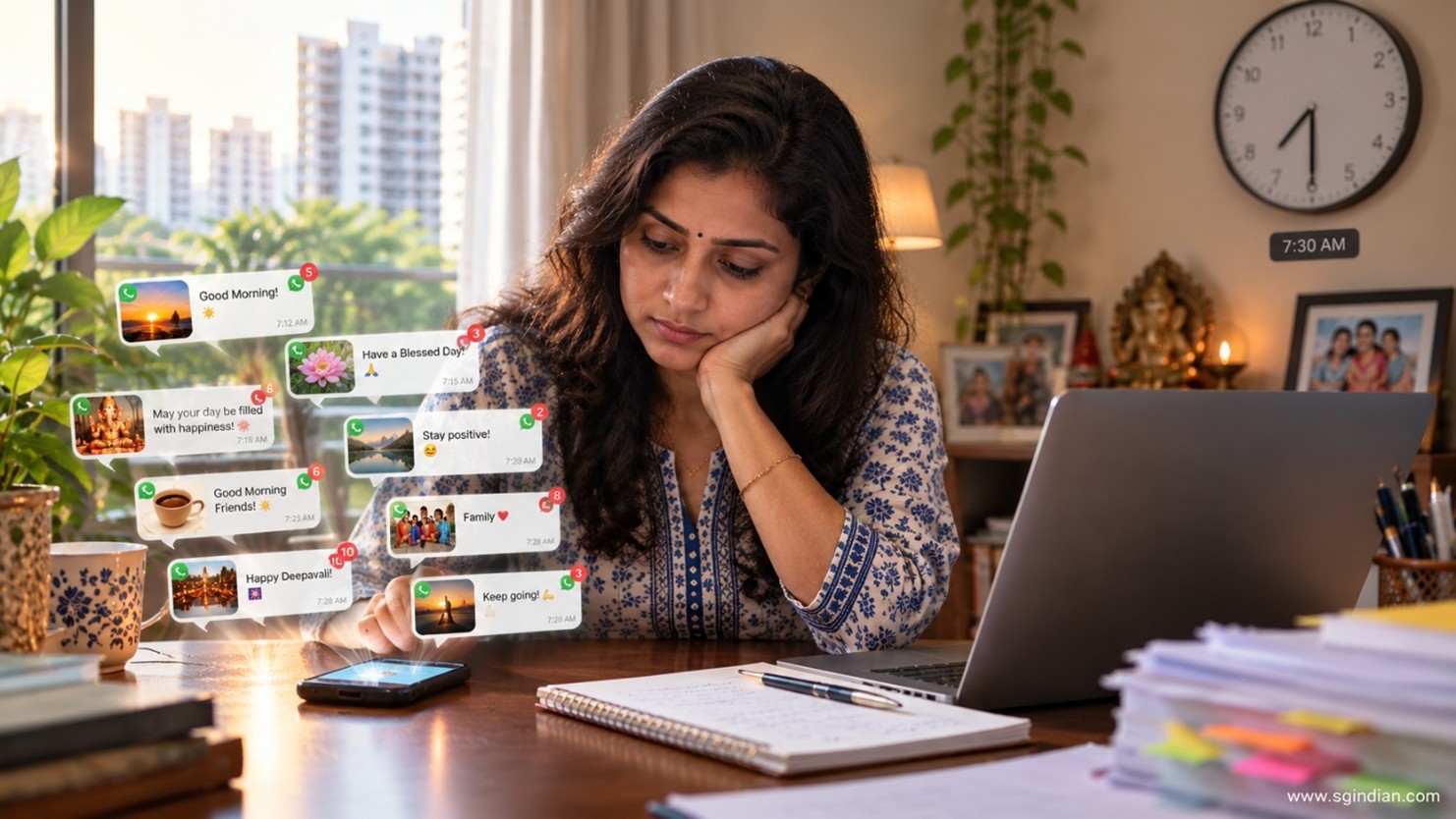
It’s 7.30 am on a weekday morning in Singapore.
Your phone buzzes. A beautiful sunrise appears, accompanied by a cheerful “Good Morning! Have a Blessed Day!”
You smile.
A few seconds later, another arrives. This time, Lord Ganesha is blessing you with happiness and prosperity. Then comes a waterfall, a bouquet of roses and a motivational quote reminding you that discipline is the secret to success.
By 9 a.m., you’ve received your tenth morning greeting. Your family group is active, your old schoolmates are exchanging jokes, and a relative in India has forwarded a video promising to change your outlook on life. Do you really recall or remember any of the motivational messages, or do you find that it disrupts your focus and takes up your precious time?
Meanwhile, you haven’t even started working on your own goals for the day.
Sound familiar?
It’s a hypothetical scene, but one that may resonate with many readers in Singapore’s Indian community. From family chats and temple groups to cultural associations and friendship circles, WhatsApp has become part of how we stay in touch.
During Deepavali and Pongal, the greetings multiply. Colourful images, blessings and heartfelt wishes travel between relatives and friends, sometimes across continents.
There is something genuinely touching about this.
But it also raises a question worth considering: Is it really necessary to send so many motivational messages every morning in a single chat group? Would your time be better spent calling and speaking to someone whom you have not spoken to in a long while? How many of the inspirational messages we receive in a day do we actually put into practice or even remember after an hour?
The Love Behind Every Message
Before dismissing these messages as digital clutter, we should recognise the affection behind them. These messages are sent with good intentions.
For a parent whose children live overseas, a morning greeting may be a simple way of saying, “I’m thinking of you.” For old schoolmates who rarely meet, sharing a joke keeps friendships alive. For someone living alone, a message from a familiar person can bring a moment of comfort.
WhatsApp can strengthen connections, but the value of a message isn’t measured by how many people receive it. A personal note asking a friend how they’re coping may mean more than another beautiful poster sent to 20 groups. And sometimes, what someone needs isn’t another inspirational quote. It’s a listening ear, a helping hand or a little of our time.
How much time do people spend on WhatsApp?
The most useful comparable figures come from the Digital 2025 Global Overview Report, published in February 2025 by We Are Social and Meltwater, using data.ai measurements from November 2024.
Average monthly WhatsApp usage, Android users
| Singapore | India | Worldwide* | ||
| 14h 40m | 15h 30m | 16h 20m | ||
| ~29 min/day |
~31 min/day |
~33 min/day |
Source: data.ai, November 2024; published February 2025. Daily figures are calculated by dividing monthly totals by 30 days, not independently measured daily averages. *Worldwide excludes China.
The Hidden Cost of Constant Forwarding
Imagine concentrating on an important proposal when your phone lights up. A motivational video. A family photograph. A message urging you to stay positive. You check one, then another. By the time you return to work, you’ve lost your train of thought.
Research supports the conclusion that digital interruptions can disrupt attention and impair performance, although the impact varies according to the task, notification and person. Research published in Computers in Human Behaviour in 2026 found that social media notifications could temporarily slow cognitive processing by approximately seven seconds under experimental conditions. This does not mean every notification cost seven seconds or that everyone takes the same time to regain concentration.
Now consider a simple calculation. If you spend just 20 seconds reading each of 10 unnecessary forwarded messages daily, that’s 200 seconds a day. Over a year, it adds up to approximately 20 hours and 17 minutes. That’s more than two and a half eight-hour working days.
This is an illustration, not a measured average. And certainly, not every minute spent on WhatsApp is wasted. A meaningful conversation with family or friends can be time well spent. But imagine what we could do with even some of those reclaimed hours. Read a book. Learn a new skill. Exercise. Visit a relative. Volunteer for a community cause. Help a student who needs encouragement. Or focus on the task at hand and complete it in 15 minutes instead of 30, without being distracted by a constant stream of motivational messages across 10 different WhatsApp chats. Worse still, some of these are identical messages forwarded by the same person to several groups you both belong to.
There’s nothing wrong with sharing inspiration. But when we spend more time reading and forwarding motivational messages than actually putting their advice into practice, we should ask ourselves: “Are these messages inspiring us to become better people, or merely distracting us from doing the things that matter?”
There is also the matter of phone storage. Depending on our settings, WhatsApp can automatically download photographs, videos and other media. Over time, files we rarely revisit can occupy valuable space.
From Inspirational Words to Meaningful Action
Perhaps it’s time to rethink how we use WhatsApp. We don’t need to stop sending greetings, celebrating festivals or sharing messages that lift someone’s spirits. But we can be more considerate.
Mute groups that interrupt us unnecessarily. Review automatic media downloads. Avoid repetitive forwards. Send personal messages instead of distributing the same greeting to everyone. Some chat groups have banned members from sending good morning and motivational messages. Others have a specific purpose for the chats, and only messages related to the chat are allowed to be sent. Others simply do not participate in certain groups where the messages can go into the 100s in a day.
More importantly, consider what those motivational quotes are asking us to do. We forward messages about kindness. But when did we last check on a friend going through a difficult time? We share quotes about gratitude. But when did we last thank someone who made a difference in our lives? We circulate reminders about discipline and self-improvement. But are we making time to improve ourselves?
And when we share messages about compassion and generosity, are we extending that compassion to people who genuinely need help?
These questions aren’t meant to make anyone feel guilty. Good intentions matter. But putting motivational messages into action can make them far more meaningful. A call to an elderly relative, an offer to help a struggling neighbour, or an hour spent mentoring a young person may leave a deeper impression than dozens of forwarded quotations.
Tomorrow morning, your phone will probably buzz again. Another sunrise. Another blessing. Another reminder to be kind, grateful and positive. Enjoy the thought behind it. But before forwarding it to another 20 people, consider doing something different. Call someone you haven’t spoken to in months. Help someone who needs support. Take one small step towards a goal you’ve been putting off.
After all, the best way to share an inspirational message isn’t always to forward it. Sometimes, it’s to live it.
Comment on this Topic